
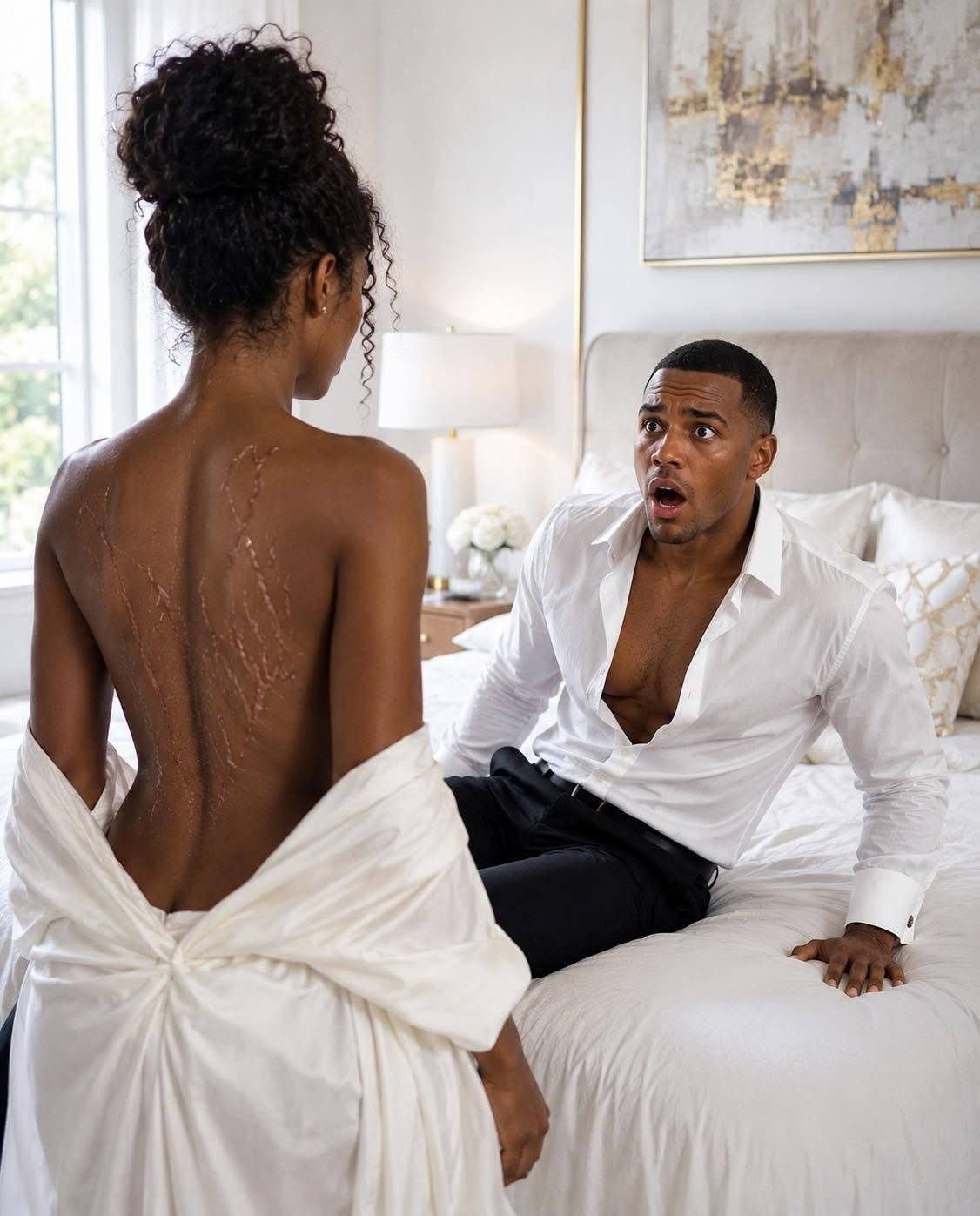
Nathan stood as if the air had turned to glass around him.
Emily’s hand froze on the strap of her nightgown. Her face, already pale with nerves, lost the last trace of color.
There were no stretch marks.
No signs of childbirth.
No marks of a woman who had carried three children.
Instead, across Emily’s back, ribs, shoulders, and the side of her waist were scars.
Not small ones. Not old childhood scratches.
Deep, uneven scars.
Some were thin and pale, like lines drawn by a cruel hand. Others were rough and dark, the kind that never truly healed. There was a long burn mark near her shoulder blade, and beneath it, faded bruising that had settled into her skin like a permanent shadow.
Nathan’s breath caught.
Emily quickly pulled the robe back over herself.
“I’m sorry,” she whispered.
Nathan’s eyes snapped to her face. “Sorry?”
She turned away from him. “I knew this would happen.”
“What would happen?”
“You would look at me like that.”
Nathan took one step forward, then stopped, afraid that even movement might frighten her.
“Emily,” he said carefully, “I’m not disgusted.”
She gave a broken little laugh, but there was no humor in it.
“Everyone is disgusted when they see the truth.”
“The truth?” Nathan repeated.
Emily held the robe tight around her body. “You thought I had children.”
“I thought you had three children,” he said. “Johnny, Paul, and Lily.”
At the sound of those names, something inside her seemed to collapse. She sat on the edge of the bed, her knees close together, her shoulders drawn inward.
Nathan knelt in front of her, still in his white shirt from the wedding reception, the cufflinks his father had once worn glinting under the bedroom light.
“Emily,” he said softly. “Who are Johnny, Paul, and Lily?”
For several seconds, she did not answer.
Then she lifted her eyes.
“They’re not my children.”
Nathan’s face changed.
“They’re my siblings,” she said.
The room became still.
Emily swallowed. “Johnny is twelve. Paul is eight. Lily is five.”
Nathan stared at her, the meaning slowly sinking in.
“I raised them,” she continued. “After my mother died. After my stepfather…” Her voice broke, but she forced herself to continue. “After he decided children were only useful if they could earn him money.”
Nathan’s hands curled into fists.
Emily looked down at them and shook her head. “Please don’t be angry.”
“I’m already angry.”
“Then don’t show it to me,” she whispered. “I don’t know what to do with anger.”
Those words hurt him more than the scars had.
Nathan sat beside her instead of kneeling before her. He kept a careful distance, giving her space, letting the silence tell her she was safe.
“My mother was a seamstress,” Emily said. “We lived in a small town in West Virginia. Not much money, but she made things feel warm. She used to sing when she cooked, even if all we had was beans and cornbread.”
A faint, painful smile touched her lips.
“When I was sixteen, she died of pneumonia. It happened fast. Too fast. My stepfather, Ray, changed after that. Or maybe he was always that man and my mother was the wall between us.”
Nathan said nothing.
“He drank. He gambled. He borrowed money from men who didn’t forgive debts. At first he sold furniture. Then my mother’s sewing machine. Then our house started filling with strangers. Men who came at night, men who whispered in the kitchen, men who counted cash on our table.”
Emily pulled the robe tighter.
“I worked at a diner after school. I washed dishes. Cleaned floors. Took home leftovers. But it wasn’t enough. Ray said Johnny and Paul were mouths he didn’t want to feed. Lily was just a baby.”
Her voice became thinner.
