

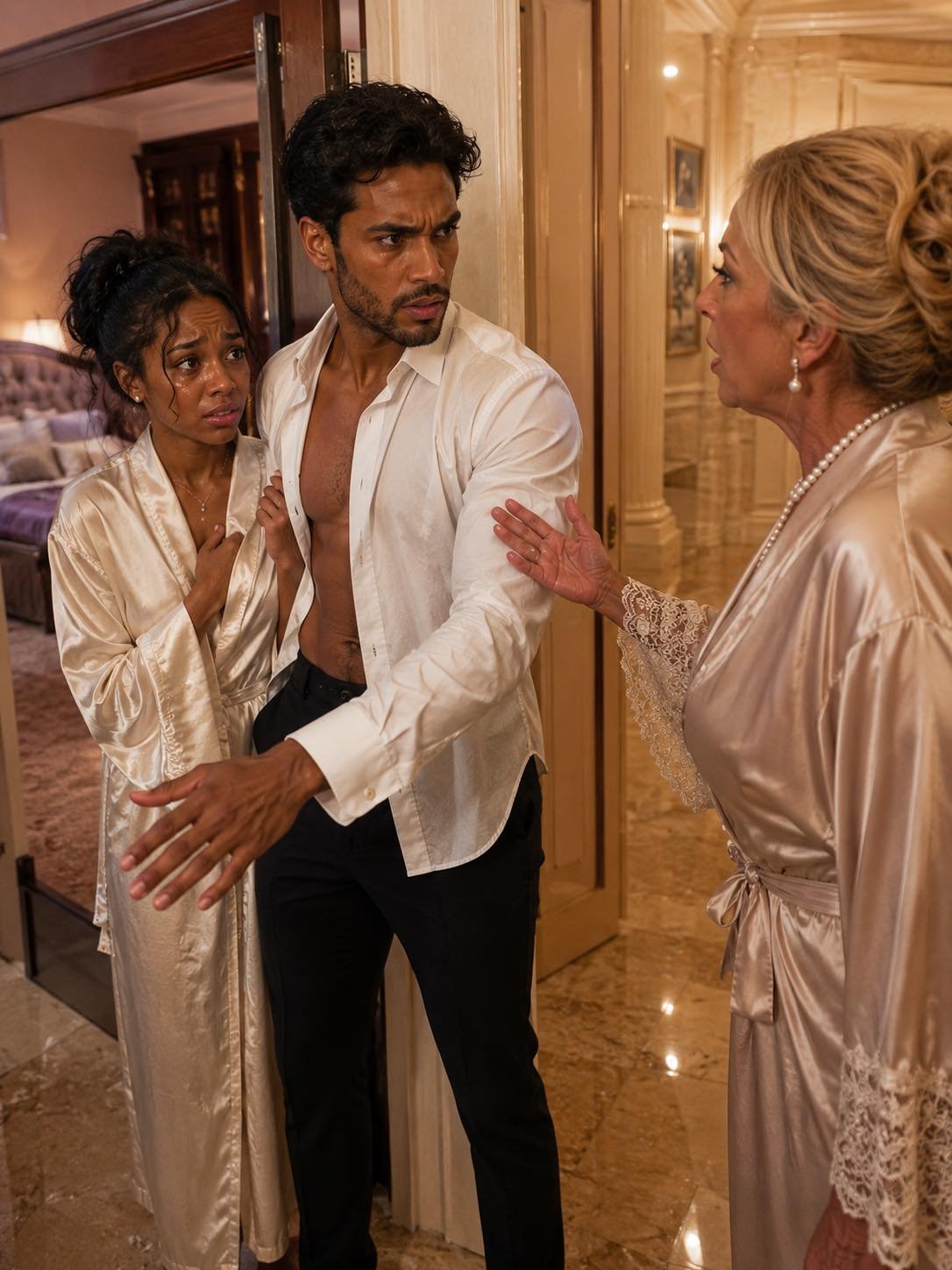
Beatriz summoned Alejandro once.
Not legally.
Personally.
A handwritten note arrived through one of her drivers.
“Come alone. Bring no lawyers. Bring no maid.”
You read that last line and felt your blood heat.
Alejandro took the note from your hand and tore it in half.
Then quarters.
Then smaller pieces.
“She still doesn’t know your name,” he said.
You looked at him.
“What?”
“She thinks calling you maid makes you smaller. But every time she does, she proves she never saw the person standing in her house for three years.”
You tried to smile.
He touched your face.
“I see you, Carmen.”
That was the sentence that kept you standing through the months that followed.
Because the case became brutal.
Beatriz’s lawyers tried to paint you as a seductress. They questioned your education, your income, your motives, your family’s finances. They implied you had watched Alejandro for years, waiting for weakness. They even suggested you had stolen copies of documents from the mansion and planted them with Rosa.
You sat through every insult with your hands folded.
The old you would have lowered your eyes.
The new you looked directly at them.
When they asked why you confessed your feelings that night, you answered simply, “Because I loved him.”
When they asked if you hoped to benefit financially, you said, “No. When he left with me, he had nothing.”
When they asked if you understood the social difference between your family and his, you smiled faintly.
“Yes,” you said. “His family had money. Mine had chairs at the table for people they loved.”
The courtroom went silent.
Alejandro looked at you like you had just handed him air.
Beatriz did not attend the early hearings.
She sent lawyers, statements, documents, silence.
Then Rosa testified.
That day, Beatriz came.
She entered the courtroom in black, pearls at her throat, her face carved from ice. She did not look at you. She did not look at Rosa. She looked only at Alejandro, as if trying one last time to remind him that he had been born from her body and therefore belonged to her forever.
Rosa took the stand trembling.
But she spoke.
She described the night Don Esteban died. The weeks after. The papers Beatriz ordered burned. The notary visits. The employees dismissed. The bracelet she was accused of stealing after she questioned a file. She described Alejandro as a young man being slowly convinced that incompetence was his natural state.
Beatriz’s lawyer attacked her.
Rosa held firm.
Then Alejandro’s lawyer presented the copied letter from Esteban.
Beatriz’s face changed.
Just enough.
The judge noticed.
So did you.
When Alejandro took the stand, the courtroom felt like it was holding its breath.
He spoke not like an heir, not like a victim, but like a man finally separating love from obedience.
“My mother taught me that family was a room I could be locked out of if I disobeyed,” he said. “Carmen taught me family is where someone tells you the truth even when it costs them.”
Beatriz stared forward.
Her jaw trembled once.
He continued.
“I am not asking this court to punish my mother for being proud, controlling, or cruel. I am asking for the truth about what my father left me.”
Then he looked at her.
For the first time in months, mother and son faced each other without walls, servants, lawyers, or marble between them.
“And I am asking to be free.”
That was the day Beatriz lost him.
Not legally.
That would come later.
She lost him in the silence after that sentence, when he did not look away and she realized fear no longer brought him home.
The ruling took three months.
