

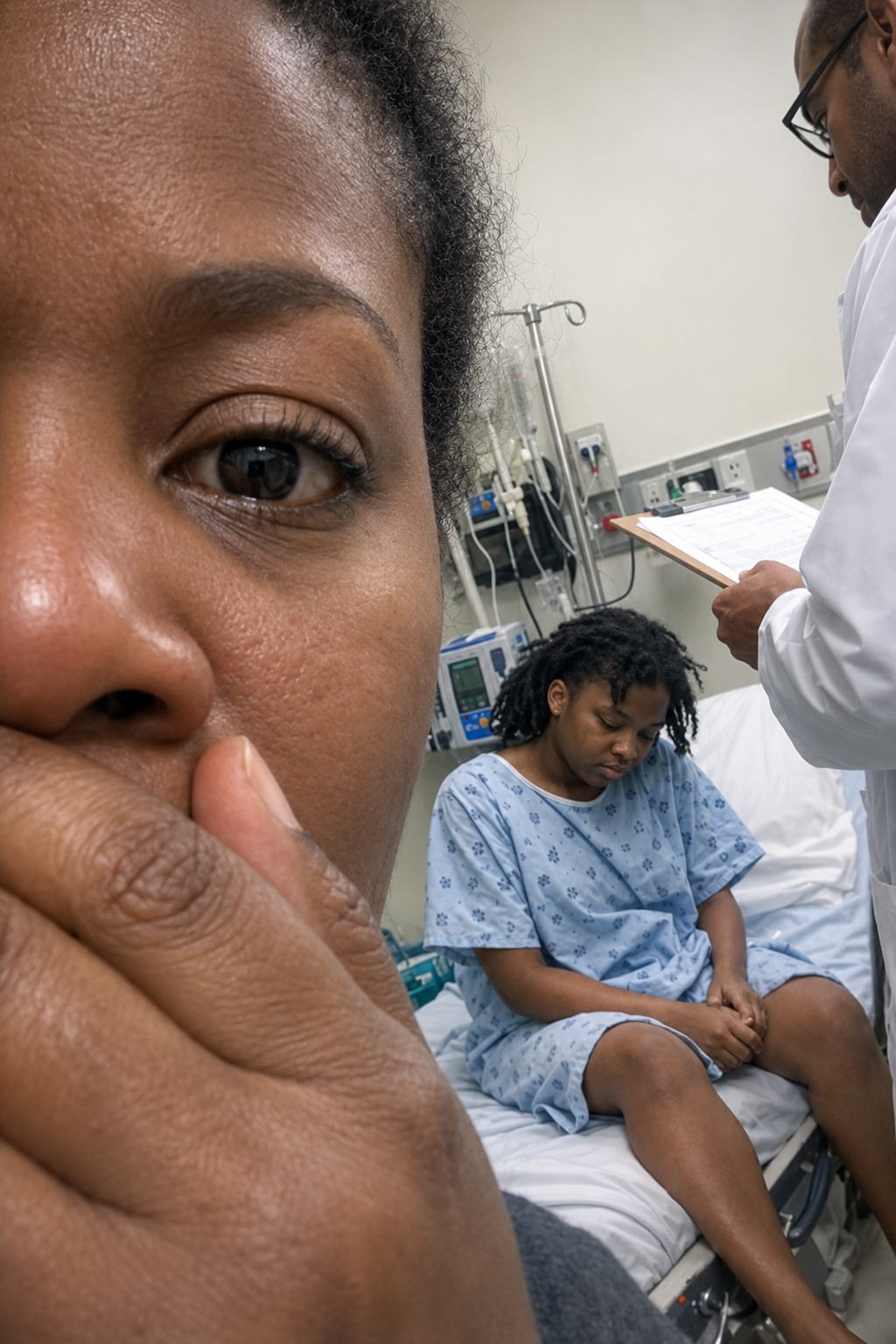
I watched her push food around her plate at dinner, claiming she wasn’t hungry. I watched her flinch when she bent down to tie her shoes. I watched her retreat further into herself, like a door slowly closing on the child I knew.
What scared me most wasn’t just the physical symptoms.
It was the silence.
Maya used to tell me everything — boys she liked, dreams about college, fears about the future. Now her answers were short, cautious, guarded. And whenever Robert walked into the room, her shoulders would tighten, just slightly — but enough for a mother’s heart to notice.
One night, well past midnight, I heard a soft, broken sound coming from her bedroom.
I opened the door quietly and found her curled into a tight ball on her bed, knees pulled to her chest, tears soaking her pillow. Her face was twisted in pain.
“Mom…” she whispered, barely audible. “It hurts so bad. I can’t make it stop.”
That was the moment my hesitation shattered completely.
---
A decision made in secret
The next afternoon, while Robert was at the office for a “critical meeting,” I told Maya to grab her jacket.
She didn’t ask questions. She simply nodded and followed me to the car, moving slowly, as if every step cost her something precious.
We drove to Clearview Regional Hospital, a solid community medical center on the edge of town. Maya stared out the window the entire ride, her reflection pale and fragile against the passing scenery.
Inside the ER, nurses took her vitals. A doctor ordered blood work, an ultrasound, and a CT scan. I sat in the waiting room, twisting my hands together until my knuckles hurt, my mind racing with every worst-case scenario a mother could imagine.
