
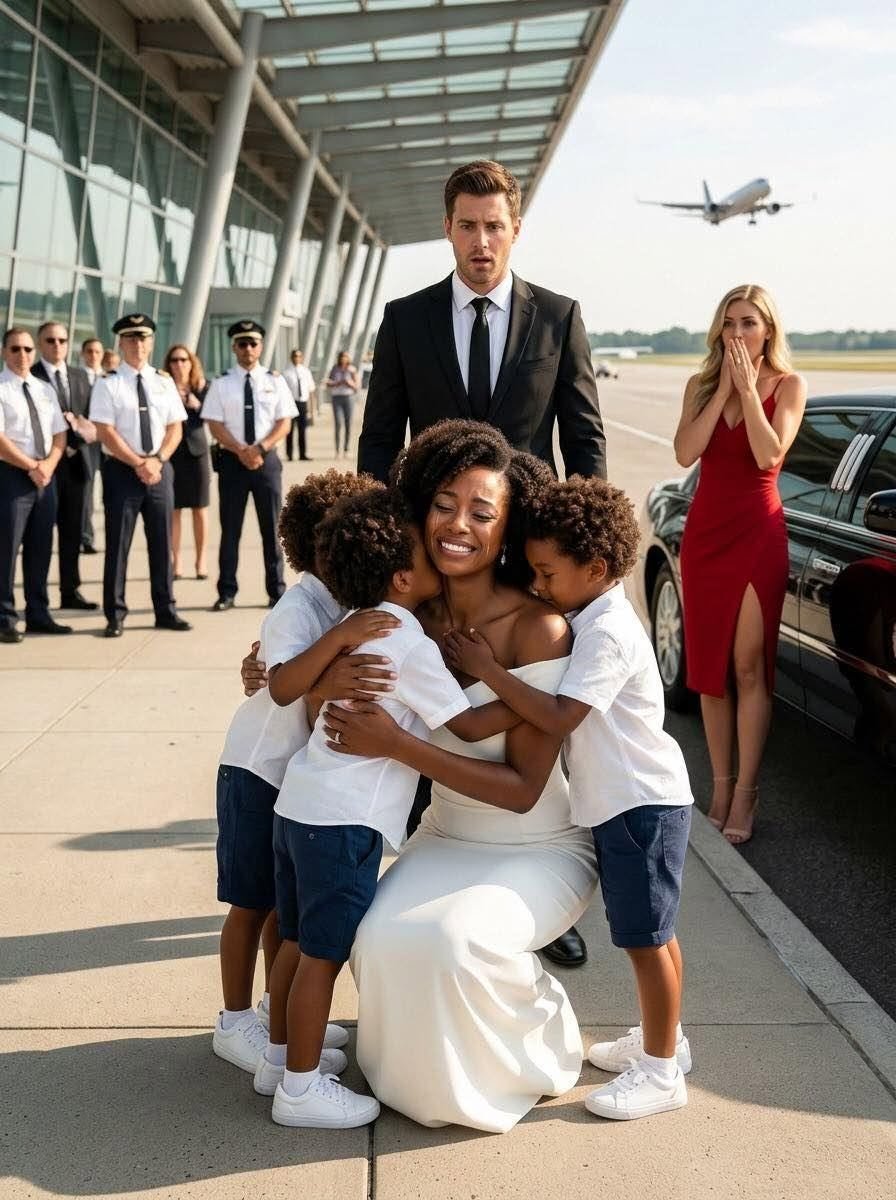
I already knew.
I let it ring.
It stopped.
Then came a message.
Emma. Please. I need to talk to you.
I turned the phone face down.
Priya watched me carefully. “He won’t disappear now.”
“I know.”
“Are you prepared for that?”
I looked toward the boys.
Noah was explaining to Liam that jumping on hotel furniture was not illegal but was probably against hotel rules. Oliver had found the room service menu and was staring at it with reverence.
“No,” I said. “But I’ll have to be.”
Two hours later, I stood in a glass conference room on the thirty-sixth floor of Meridian Green’s headquarters, wearing a navy suit and the calm expression I used when wealthy men underestimated me.
There were twelve board members seated around the table.
And one empty chair at the far end.
I noticed it immediately.
So did Priya.
She leaned toward me. “Were we expecting one more?”
“No.”
The chairman, Andrew Vale, smiled warmly as I connected my laptop.
“Dr. Winters, we’re honored to have you here. Your storage model has generated significant interest.”
“Thank you,” I said. “I believe it can change how cities handle renewable overflow.”
“It already has,” someone murmured.
That voice came from behind me.
I turned.
Blake Harrington walked into the room.
For one suspended second, the entire world narrowed to the sound of his footsteps.
He had changed clothes. Gone was the travel-wrinkled shirt from the flight. Now he wore a dark tailored suit, his hair combed back, his face unreadable.
The board members straightened.
Of course they did.
Blake did not enter rooms.
He occupied them.
Andrew stood. “Mr. Harrington. We weren’t sure you would make it.”
My stomach dropped.
Blake’s eyes met mine.
“I wouldn’t miss it.”
Priya whispered under her breath, “Oh, you have got to be kidding me.”
I forced myself to look at Andrew. “I wasn’t aware Mr. Harrington was involved.”
Andrew seemed suddenly uncomfortable. “Harrington Energy holds a minority strategic position in one of our funds.”
“How minority?” I asked.
Blake answered. “Enough to have a vote.”
The room chilled.
Five years ago, his presence would have shaken me.
Now, it sharpened me.
I smiled.
“Excellent,” I said. “Then I hope Mr. Harrington enjoys the presentation.”
For the next forty minutes, I gave the best pitch of my life.
I spoke about grid instability, battery degradation, predictive distribution, and modular storage systems capable of reducing urban energy waste by nearly thirty percent. I showed pilot data from three municipalities. I explained why Winterlight’s design was smaller, cheaper, and cleaner than anything currently on the market.
I did not look at Blake.
Not once.
But I felt him watching me.
When I finished, the room was silent.
Then one of the board members, a woman named Celia Brandt, leaned forward.
“Dr. Winters, this is extraordinary.”
“Thank you.”
Another man flipped through the report. “Why haven’t we heard more about Winterlight before?”
“Because we were busy making the technology work before making noise about it.”
A few people smiled.
